Showing posts with label hemlock. Show all posts

Saturday, December 15, 2012

Maine Firewood Values in BTU

Heat Values for Common Maine Firewood.


I grew up with a couple of woodstoves, and have gotten used to "just knowing" which wood is best for heating the house, and how much heat I'll get from a particular stove-load of firewood. I can tell how long I have before I should look at stoking the fire again, by what I've put into it, and how well it's burning. This becomes second nature after a while, honest. If you are new to wood heat, it may seem like just too many variables, too many maybes. Sometimes you go to bed with a stove full of wood and wake up to good coals, sometimes it's all gone by morning. Trust me, it will make sense after a while.

The heat generated by burning wood is measured in BTUs, or British Thermal Units. Briefly, a BTU is the amount of heat needed to raise a pound of water from 39 degrees to 40 degrees fahrenheit. Most of the world measures heat by joules, but the BTU hangs on in talk of furnaces and wood-stoves. Specifically, firewood is rated in milllions of BTUs per cord. To complicate things a little further, there's the factor of how much of the heat is expended vaporizing the water contained in the wood. Now to be frank, I ran into this in my research and thought, Huh. the heat doesn't leave the house other than up the chimney, whether it's vaporizing water in the wood or not. Why should it matter? I found lists showing the effective heating of wood after considering this factor, lists that showed the raw heat availability, and lists that showed both. Some of them seemed to conflict with my experience of the heating utility of the kinds of wood that I'm used to. The sources that most closely match my experience, using the wood I almost always burn, yield these results. In Maine, most of what your likely to burn is listed here, with the best heat-providers at the top.

To be clear, if you burn softwood, like dry pine or cedar, it will burn hot. But it will burn up and become ash very quickly, compared to the hardwoods. I include hemlock because it lasts a bit longer than that, and is a good wood to include in your firewood mix to use for morning fires, just getting the heat going quickly.


There are considerations, of course. Poplar starts to rot very quickly if it is not split right away, same as all kinds of birch. Hornbeam and oak, while great heat sources, are best added to a fire that is already hot and underway. It is much easier to start a fire with hemlock and maple. Smaller pieces burn up faster than bigger pieces. If you are new to wood heating, at least try to get the hang of this; when you are there to tend it, run a smaller fire, but hotter (more air, more flame). Tend it often, adding just a stick or two. This will be quick, hot fire that will be better for your chimney, and honestly more enjoyable to look at. When you go to bed, or when you leave for work, stuff your stove with larger pieces of wood from the top of this list, and give it less air. It will burn slowly, but long. The downside of those long burns is the creosote buildup in your chimney. You can combat this by running the fire hotter when you are at home.

 Another consideration is that while oak and ironwood are your greatest heaters, they also grow slowly, ironwood especially so. You can't use several cords of ironwood annually for very long before you run out of it, and have none left growing. A variety is good, and leaving the right blend of younger trees behind to mature is also good.

Thursday, September 27, 2012

Last Child in the Woods? Not Yet.

When I was about ten years old, my family moved from a small suburban home to a couple of dozen acres of freshly harvested pine forest. The land was littered with branches and huge stumps, with smaller trees leaning in to fill the empty spaces overhead left by the fallen pine giants.Even so,  I found those woods to be magical, and we were surrounded by plenty of undeveloped woods. Until then, my idea of "forest" had been an acre or so of woods tucked between our neighborhood and the nearest main road. The reality of a couple of square miles of trees, trails and streams was amazing.

I just love trees!
I learned to go deep into the woods, far enough to hear nothing but birds and rustling critters. When I wrapped my arms around the larger trees, I could feel the earth and wind through them. The rough bark on my cheek, the constant whispering of the leaves, the ankle-deep moss, soaked into me, made me a country boy in no time. Inspired by Robert Frost's poem "Birches," I climbed leggy trees until they bent to let me down. I felt that call to climb into the heights of the branches, and beyond, but also the pull of the earth below, so eloquently described by Mr. Frost nearly a hundred years ago. As he wrote, earth's the right place for love, but also, one could do worse than be a swinger of birches. 

Beeches in winter
Inspired by the Tarzan novels, I made pathways among the trees, lashing cedar logs between the upper trunks with nylon baling twine. I would run along these balance-beams, hanging onto branches, from one tree to the next, and the next, and never fell. I know that my father, who grew up with a forest too, not far away, knew the importance of giving his children such an opportunity. Those seasons among the trees impressed me deeply. Years later, when I was at last able to build my own home on that same acreage, using some of the trees that I had known as a boy, it felt like I had never left.

Among the hemlocks that I cut, peeled, and dragged out for floor framing was one that had grown around some knotted nylon baling twine about twenty feet off the ground. When I discovered it, I realized it was the only remaining trace of those treetop trails I had built. Those days of playing Tarzan came back to me in a rush, and I gave that particular log a place of honor in the house. I know exactly where it is under the floor-boards now. I think of how I've come back to a new beginning, and how a new generation is now held up by that log as they follow their own youthful, dreaming paths into the world by way of these acres of woods.

Think how those logs beneath our floor, cut from trees that I grew up climbing, are the foundation for the same kind of magic happening all over again. We're giving our kids the great gift of learning the smell of spring leaves, the feel of a tree beneath you swaying in the wind, the music of crisp leaves underfoot, and the crack of freezing bark in the middle of the coldest winter's nights. If I can borrow a phrase from a really important book, "The Last Child in the Woods" is still out there, and I would say that there are many of them, since I know of so many who are raising nature-aware kids. Not everyone can leave the cities and suburbs, but I am so glad that our kids have this chance, and encourage anyone to find ways to get their children out under some trees as often as they can.

Saturday, August 25, 2012

On Uncertainty

I first thought of home-building as a metaphor many years ago, when my Dad, talking about how there seems to be more to do in his home all the time, things left unfinished, early work needing to be rebuilt before planned further work is even started, said there is proverb about that.

"Confucius say, 'Man finish house, man die.' I don't know if he really did say that, but he might have..."*

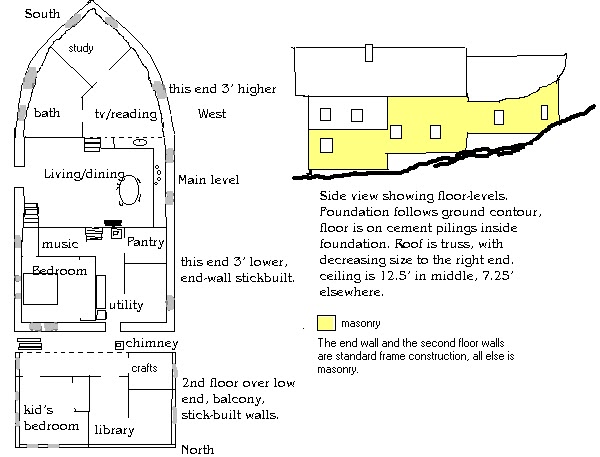
Floor plan from years ago...updates needed!
Musing about that has taken me very far into what I know about my place in the world, as it relates to my home. The structure is an extension of me, all parts built for a reason, to shelter, warm, hold up, express, comfort. If it is ever fully completed, I can only imagine the great sigh of satisfaction that will whoosh out of me, but...then what? I hope that there will always be more to do, new needs to meet, adjustments to make so as to keep up with changes, in the house, in my life, in the needs of my family.

When I was building the cordwood walls, more than a decade ago, I would take my lunch and a beer, sit on the highest point of the foundation, and imagine the fully formed home that was taking shape so slowly in front of me. From that vantage, the curved walls of the house reach out and downhill, like your arms when you are reaching for a hug. I came to think of those walls as my arms, aware that they would shelter, welcome, and comfort the people that I bring into my life, family and friends. That visualization is very powerful for me, especially now, as I ready myself and the house to welcome my Honey and the kids, and occasionally all of the new people in her extended family, parents and siblings. My grown daughter is on her own path, and those arms/walls have been empty except for my own presence for enough time that I know I am ready, the house is ready, to fill with laughter, footsteps, rattling dishes, cooking smells, brother-sister arguments, frisbees...okay, the frisbees will be outside, first rule.

Furthering the metaphor, my style of working on the house is a reflection of life, at least to my mind. I'm looking at the stairs in this picture, and seeing so much as I contemplate the logistics of getting that railing to turn a corner and go down to the first floor, sturdy and attractive.

Without going into too much detail, I'm working out how to fasten, support, and shape an armload of wood so that it has rigidity carried up from those heavy hemlock logs on each side of the treads. It's complicated, and involves trusting that a little support and strength from each piece will combine into a sturdy whole, and that little flaws here and there will become, when all is said and done, not problems, but character. I'll trust my experience, trust the materials, trying to foresee potential errors, not borrowing trouble, but looking for the way to proceed that makes the best use of the situation. When it's done, the girls will have support to hang onto as they climb to their rooms, unaware of the work and care that went into it, but with a sense of security that will serve them well. The philosophizing that is going into this may escape them as well...

Where does the work on the stair end, and the metaphor for good work in my life begin? I have made plenty of mistakes, done things poorly that I can't undo. I can only try to make the most of the result, and try to do better going forward. I have also done things well by blind luck, like having an extra room or two planned in, long before I knew that I would have this incredible woman with her beautiful family joining me. The "study" in the floor-plan above, is now going to be "the boys' room," and the "library" will be "the girls' room." Metaphor or simple reality, I only know that it is all meaningful to me, and that I will bring my best to it with as much awareness and heart as I have in me.

*On random coolness (serendipity?), I did a search for the phrase, and found it quoted by Bryce Black, who seems at first glance like somebody I have a lot in common with, and really interesting! I guess my Dad didn't make that one up after all...

Hemlock Balcony and Stair Railing

The balcony before the railing.
I've alluded to this already, and there are already one or two photos of the railing that I've been working on, but I want to review the whole project in one post, to show how it all fits together, and how you can do it. I received a great compliment a few days ago, when Kissy from Dragonfly Acres, who will be building a cordwood masonry house with Ben not far away over the next couple of years, took one look at it and said, "I'm totally stealing that idea!" It was really easy to put together, and used a lot of material from the land, instead of from the store, so read on...

Hemlock logs for stair support.
What I had for years was a balcony with a temporary railing screwed together from three-inch strapping, draped with fabric to cover the scrap-lumber storage that had taken the space over, and stairs quickly knocked together from scrap two-by-sixes. (The photo above left shows what I had after taking down the "temporary" railing.) Then last year I scrapped the temporary stairs and made extremely heavy-duty stairs from two large hemlock logs (my best free-hand chainsaw work to date) with oak risers and treads.

This spring I cut and peeled about a hundred small hemlock trees, leaving the +/_ four-foot lengths to dry for a few weeks. A good thing about hemlock is that in spring and summer you can easily peel it with no tools at all, and the sap is not sticky, unlike pine or spruce. It's also remarkably hard and strong for a softwood, so is especially suited to uses like joists, stringers, studs, sub-floor planks, and stair-railings. It is hard enough that you'll want to drill a pilot-hole for everything, to avoid snapping screws, bending nails, or splitting the wood. (Side note, and maybe a future post: hemlock bark is really nice for basket-weaving. You can easily cut strips of a needed size out of your peelings, and they remain flexible for an hour or two without soaking. They dry hard, like wood. With age it becomes brittle, but is very pretty for decorative uses.

Scooby likes the new work.
Milled overlap, and bungees.
 After VERY carefully trimming the knots on a tablesaw, then hand-sanding with a sanding sponge, I organized the pieces by diameter, and cut a flat segment into the bottom eight inches or so of all of the ones I wanted for the balcony railing. The pieces for the stairs didn't need a flat surface. Then, going with about a five-inch on-center spacing, I attached them to the balcony with two screws apiece. They started out sticking up at all angles, but roughly vertical. That didn't worry me; I had a plan!

This ragged look cleans up nice...
Here I have to confess that I bought the boards for the top of the railing. If I hadn't been in such an all-fired hurry to make things ready for Honey and the kids to  be able to use the space, I would have taken a little more time, used reclaimed wood, and just spent more time sanding and fitting it. So yes, I bought a few running feet of pine board in three and four inch sizes, milled an overlap for them, as seen in the photo on the left here, and got to work with screws and glue, using bungies to hold the boards in place while I worked. One of these days, I may do a post about the crazy things I've done in the name of not asking for help...
  
I really like the natural look of these uprights, much more than store-bought straight pieces, especially in a rustic space like Ironwood Hollow. It looks more like live stuff, and so much more individual and interesting! Once the balcony was finished, I spent a few days in a staring contest with the stairs. It's hard to describe all the variables that I was debating with myself, but in short, I wanted to turn the corner neatly, go down the stairs, have it be sturdy to lean against, and just look neat and clean. What I ended up doing was having two uprights per tread, with every second one being screwed to the riser on the tread above it. I used a one-inch forstner bit for really neat holes for each of these, and shaved each upright carefully to fit just right. Okay, here's my confession (don't tell the kids); I was a little concerned about the strength of all of this, and leaning hard against it didn't completely reassure me. After all, I now have teenagers. Athletic ones. Show-offs. Who have friends. They do things like hand-stand push-ups ans back-flip dives, so a guy like me can barely keep up... You can see where I'm going, right? One of these days, I come home to find my quaint hemlock railing in pieces, and one of the kids' friends being picked up by upset parents after they've crashed into the lower level followed by a bunch of toothpicks that used to be an artistic railing...
The final product, no sliding allowed!
So, don't tell the kids, but I stood on the balcony railing, and actually jumped up and down. And I slid down the railing. Several times, because it was so much fun. Er, I mean, just to make sure it's safe for the kids. But still, there'll be a house rule, can't have them thinking it's a jungle gym around here, right? Oh, and then I hand-sanded some more, not going to elaborate on that.

As a last note, you may note the remaining railing mounted to the cordwood wall. That's just a cedar board with spacers for your right hand going up, and next year, when I can cut and peel more hemlocks, I'll replace that with a railing to match the one in the foreground. Since I use our property as a firewood lot, every small softwood that I can use productively opens up the lot for more usable hardwood, so I'm always looking for new uses for hemlock, cedar, spruce, and pine, which are my local non-firewood species. The added benefit is that this railing would have cost hundreds and hundred of dollars if I had bought all of the materials. Built this way, I have the benefit of clearing some softwoods from my woodlot, and managed to build a unique part of our home at a total expense of about eighty dollars.
The full railing with a view of the main floor.

Wednesday, August 8, 2012

Ramblings and a Tip

Carrying wood without wrestling with it!
As you know, I have been using peeled and hand-sanded hemlock for the uprights of the balcony railing. The stair railing is up next, using similar methods, but in the interest of giving myself time to figure out how to do that well, I confess that I am finding other things to do with my renovating time. I turned a bookshelf into a shelved door for the pantry. I walled over an opening in the main bedroom (more on that later). I did some awesome locavore cooking with a jar of barbecue sauce made by the incomparable Craig Hickman at Annabessacook Farm (probably more on that later). I wrote another song, spent lots of time polishing up my enunciation to get ready for my big audio recording effort (definitely more on that later).

The last thing I could thing of to do is to trim out the upstairs bedroom door, on the outside where it shows to the main living space. I wanted to do something that would match the balcony work,  so I went out and cut some more hemlock, peeled it, and took it up to the family workshop.

Okay, here's a bit of a reveal. I have a utility room that has all my motorcycle gear, the cats' stuff, and all the assorted hand-tools necessary for minor work: a hand-saw, a cordless set of tools, hammers, pliers, chainsaw, a bit of electrical and plumbing gear, and so on. What I do not have is a workshop. I have sawhorses in the yard. When I need to use a tablesaw, a drill press, dado blades, or anything of that nature, I take whatever I'm working on and trudge up to the neighbor's house, where there is a workshop that I can use.

The family workshop
Hah! Okay, got you feeling sorry for me, right? Here's the workshop:

Trudging a couple of hundred yards next door to my father's home (for sure, more on him later!) to use his beautiful stone workshop, is a pure pleasure. It's outside of the home I grew up in, a slipform stone structure that could teach Ozymandias a thing or two. One of Dad's numerous remarkable achievements, it is very satisfying to work in.The hike adds time to my work, particularly when I'm fine-tuning one piece of wood at a time, but on the other hand it gets me out in the air, or else forces me to do things with simpler tools more often. It's amazing what can be done with a hand-saw and a hammer if you don't need to rush.

Don't be this poor guy!
So anyway, I have some large pieces of hemlock peeled, dried, and ready to become door-trim. Also have sixteen pieces of smaller hemlock ready to become stair railing uprights once I figure out how to turn a corner with the railing, and how it will be supported. Got them all in a pile, and realize that I'm going to look like the tarot card, ten of wands in a minute. Falling all over a lazy-man's load of wood is an old pattern with me, but I have a brainstorm. If I take a piece of rope, loop it like a firewood carrier, I can actually carry all these pieces without fetching up on every stair tread, doorway, and tree along the way!

This is so much easier...
Problem solved, I take all of my hemlock up to the workshop, and spend some time carefully carving the knots off of it, and halving each of the larger pieces lengthwise. This gives me, in just a few minutes, a good bundle of usable sticks that only need a minute or so apiece of hand-sanding with a sanding sponge before they are ready.

I have to say a couple of things here. My photos show me working on  a bare blade, working each piece of hemlock by hand without much in the way of protection. A table-saw can do sudden and irreparable damage to your fingers, so please exercise all due caution. I have a lot of experience with this, and am so aware of the dangers involved that I have never been within a country mile of an accident. Don't be casual or complacent with power tools!

The other thing about this is that, after handling almost twenty pieces of hemlock, free-handing them around a high-speed blade, I promptly went back to Ironwood Hollow and cut myself badly with a handsaw. So here's your second warning; hand tools are dangerous too! I managed to hit my thumb hard enough with a handsaw to make cuts that bled for an hour, and made the tendon on the palm side of my thumb really really tender. This reminds me of the times when I have been meticulously careful with a chainsaw, cutting cord after cord of firewood, wearing all the right protective gear, without incident, and then, right away, flattened my thumb with the limbing axe or splitting maul. So please, people, be careful even with the manually powered tools.

Long story short, I got the trim halved, the various pieces cleaned up on the table-saw, and had enough time left in my evening to start in on the stair railing.  That will be another post or two, and I am thinking I had better talk a bit about my Dad, the genius behind the workshop, his garden that provides beautifully for so many friends and family, and the way he instilled in me values that have evolved into my love of alternative and natural building, living frugally, and taking Nature as a partner in so much of life.